On 6 April 2027, the Making Tax Digital threshold drops to £30,000. That single change brings an estimated 1,077,000 more sole traders and landlords into quarterly digital reporting.
Here is the part that catches people out. The test uses the figures on the 2025/26 tax return, the one due to be filed by 31 January 2027. So the number that decides whether you join in April 2027 is a number you are finalising right now.
Plenty of articles will explain the policy to you. This one goes inside the software, because the real question is what happens on the screen when the deadline arrives.
Everything below applies whether you file for yourself or for a book of clients. The second half covers what changes when you are doing this twenty times a quarter instead of once.

Who joins MTD for Income Tax in April 2027?
You are in scope from 6 April 2027 if you are registered for Self Assessment and your combined gross income from self-employment and UK property was above £30,000 on your 2025/26 return.
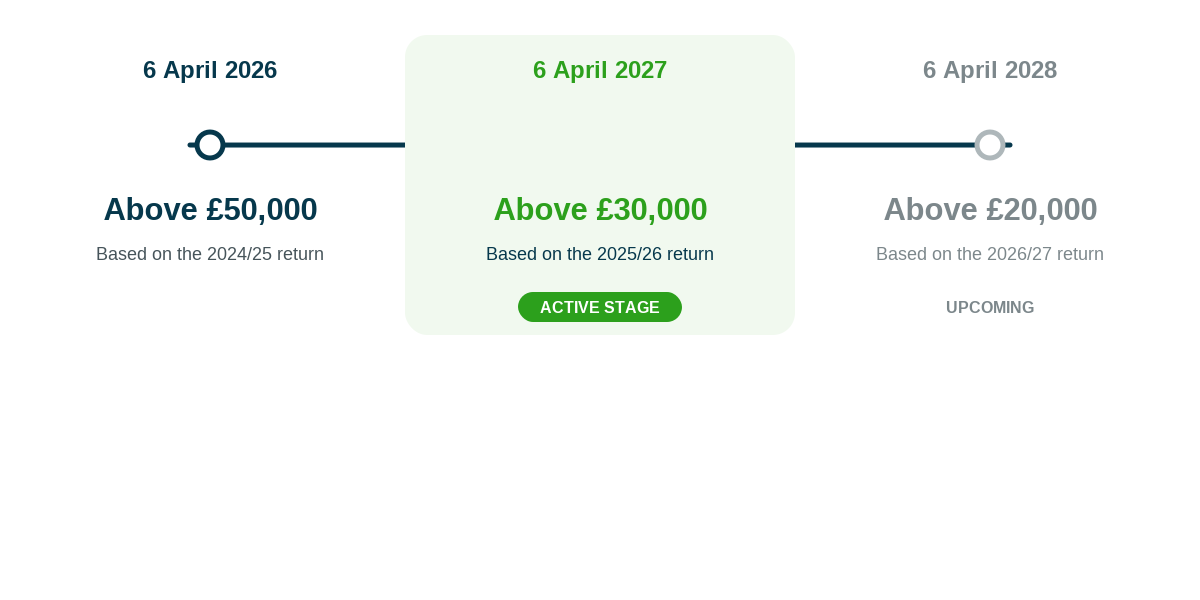
The rollout runs in three stages:
| Start date | Qualifying income above | Based on the return for |
| 6 April 2026 | £50,000 | 2024/25 |
| 6 April 2027 | £30,000 | 2025/26 |
| 6 April 2028 | £20,000 | 2026/27 |
Why the test uses gross income, not profit
This is the single biggest source of confusion, and it pulls in people who assume they are safely outside the rules.
HMRC looks at your turnover before expenses. A sole trader with £34,000 of fees and £12,000 of allowable expenses is in scope from April 2027, because HMRC looks at the £34,000 figure and not the £22,000 profit.
If you run a trade and let a property, the two figures are added together. A modest side business plus a single rental can clear £30,000 without either source feeling large on its own.
Who stays outside the rules
Some groups are exempt or deferred. Budget 2026 announced an exemption from MTD for Income Tax until further notice for four groups of taxpayers, with secondary legislation to follow, and confirmed that some taxpayers are exempt from having to comply, including foster carers. The exemptions announced until further notice include people receiving qualifying care relief, non-resident foreign entertainers and sportspeople, and customers who expect to become non-resident.
There is also an exemption for taxpayers HMRC cannot currently serve digitally, which includes insolvent taxpayers who are unable to sign up.
If none of that describes you, plan on joining.
What happens if income falls later
Crossing the threshold once is enough to bring you in. If you still have sources that are mandated for MTD, you must sign up from April 2027 even if income from those sources has since fallen below the threshold. Leaving the system takes sustained lower income across several years, not a single quieter trading period.
What is a quarterly update, and what does Xero actually send?
A quarterly update is a summary of your business and property income and expenses for a three-month period. It is not a tax return, it does not calculate your tax, and it does not ask for a payment.
Xero totals your categorised transactions for the quarter and sends those category totals to HMRC. You review the summary before it goes.
The categories Xero reports
Your nominal codes map to the income and expense headings HMRC expects. Trading income and property income are reported separately, because they are separate income sources as far as the rules are concerned.
This is why your chart of accounts matters more under quarterly filing than it did under annual filing. Miscoded transactions do not get quietly fixed at year end any more. They go to HMRC four times a year.
Quarterly updates are cumulative
This detail saves a great deal of worry, and very few guides mention it.
Each update covers the tax year to date rather than the quarter in isolation. If you find an error in quarter one when you are preparing quarter two, you correct the coding and the next submission carries the corrected position. There is no amendment process to work through and no penalty for the original figure.
Quarterly updates are a running estimate. The accuracy requirement arrives at the end of the year.
What a quarterly update does not include
Keep these out of your quarterly submissions entirely:
- Employment income and PAYE
- Bank and building society interest
- Dividends
- Capital gains
- Accounting adjustments such as accruals, prepayments and capital allowances
All of that belongs in the final declaration. If you also file VAT returns through Xero, those remain a separate submission on a separate cycle. Our guide to filing VAT returns in Xero under Making Tax Digital covers that process.
How to set up MTD for Income Tax in Xero
Xero is listed as HMRC-recognised software for both MTD for VAT and MTD for Income Tax. Setting it up takes one session. Do it well before your first quarter ends.
- Confirm the HMRC sign-up. You or your agent sign up for MTD for Income Tax through HMRC first. In some cases HMRC signs people up directly and confirms by letter or an online message. Check which applies to you before anything else.
- Authorise Xero through the Government Gateway. Xero redirects you to HMRC’s Government Gateway to grant the software permission to submit on your behalf. Keep your Government Gateway credentials to hand. Set up your income sources. Tell Xero whether you are reporting self-employment, property, or both. Each source reports separately.
- Review your chart of accounts. Check that every account maps to a sensible HMRC category. This is the step people skip, and it is the step that causes trouble later.
- Confirm your accounting period and basis. Most sole traders use the standard quarters that run to 5 July, 5 October, 5 January and 5 April. Confirm whether you are reporting on the cash basis or the accruals basis.
Which Xero plan you need
You need a plan that includes MTD for Income Tax filing. Xero Simple is HMRC-recognised for MTD for Income Tax, and you can submit all four quarterly updates and your final declaration from within the software. Larger businesses and anyone handling client work will want a fuller plan.
Check pricing directly with Xero before committing, as plans and features change.
How to prepare and submit a quarterly update in Xero
The work is in the preparation. The submission itself takes a couple of minutes.
- Reconcile the bank for the whole quarter. Every transaction, with nothing left sitting in the unreconciled queue.
- Clear uncategorised items. Anything parked in a suspense account or left without a code will either distort your figures or fail to appear at all.
- Review the quarterly summary against your ledger. Xero prepares the totals. Your job is to read them and ask whether they look right. A category that is empty, or one that is three times its usual size, deserves a second look before submission.
- Submit to HMRC. Xero gathers your figures and files each quarterly update to HMRC. Save the confirmation.
- Correct anything you find later in the next update. As covered above, the cumulative structure handles it.
[Screenshot placement: quarterly update summary screen before submission, with alt text “Xero quarterly update summary for MTD for Income Tax before submitting to HMRC”]
A practical habit worth building: do this work in the week after the quarter ends, not the week before the deadline. The deadline is a backstop, not a schedule.
MTD quarterly update deadlines for 2027/28
The deadlines are fixed. Quarterly update deadlines fall on 7 August, 7 November, 7 February and 7 May, and your tax bill is still due by 31 January.
For anyone joining in April 2027, the first year looks like this:
| Quarter | Period covered | Deadline |
| Quarter 1 | 6 April – 5 July 2027 | 7 August 2027 |
| Quarter 2 | 6 July – 5 October 2027 | 7 November 2027 |
| Quarter 3 | 6 October 2027 – 5 January 2028 | 7 February 2028 |
| Quarter 4 | 6 January – 5 April 2028 | 7 May 2028 |
| Final declaration | Tax year 2027/28 | 31 January 2029 |
Mark 7 August 2027 now. That is the date the new system becomes real.
What happens at year end: the final declaration
The final declaration replaces your Self Assessment return. It is where the year is actually settled.
All four quarterly updates must be filed first. You must file all four quarterly reports for the tax year before starting the final declaration process. A skipped update does not disappear. It queues, and it blocks the declaration until you deal with it.
At the final declaration stage you:
- Add income Xero does not hold, including employment income, interest and dividends
- Post accounting adjustments such as accruals, prepayments, capital allowances and any private use restrictions
- Review the calculation HMRC produces from everything submitted
- Confirm that you agree with the final position
You review and confirm that you agree with the tax amount HMRC has calculated based on your quarterly updates and additional income.
The payment deadline does not move. Your tax bill is still due by 31 January.
What the Autumn Budget 2026 changed for the April 2027 group
This is genuinely useful news, and it has not been widely reported yet.
The government has confirmed that taxpayers due to join MTD for Income Tax from April 2027 will not be given penalty points for late submission of quarterly updates for 2027/28. The same approach that applied to the £50,000 group is being extended to those with qualifying income over £30,000 when they enter MTD from April 2027.
In short, the second group receives the same first-year breathing room the first group received.
What the soft landing does not cover
Read this part carefully, because the relief is narrower than it sounds:
- Late payment penalties still apply. Missing the tax payment deadline costs money regardless.
- A late final declaration still earns a penalty point. The relief covers quarterly updates only.
- Skipping an update is not an option. It blocks your final declaration until it is filed.
- The relief lasts one year. A taxpayer who does not file the quarter one update by 7 August 2027 receives a penalty point from the following year onward.
What the penalty system looks like afterwards
From 2027/28, quarterly filers receive a £200 penalty at four points, and another £200 for every late submission after that. For the April 2027 group, that system bites on the 2028/29 quarterly updates.
One year of grace is useful. It is not a reason to delay getting your records in order.
Common mistakes that cause problems
- Treating the update as a tax return. It is a summary. Reliefs, adjustments and other income all wait for the final declaration.
- Leaving the bank unreconciled until deadline week. Four small reconciliation jobs beat one large one under time pressure.
- Miscoding drawings and capital purchases. Drawings are not an expense. Equipment purchases are not a running cost. Both distort your figures and both are easy to get wrong.
- Mixing trade and property income. They are separate sources and must be reported separately.
- Reading “no penalty points” as “no obligation”. The filing requirement is unchanged. Only the penalty is paused.
What this means for bookkeepers taking on MTD clients
If you work in practice, or you want to, this is the part that matters for your career.
The volume of work changes shape. A client who previously needed one annual conversation now needs four touchpoints plus a year-end process. Across a book of thirty clients, that is a different business entirely.
Timing matters more than deadlines. Practices that wait for the deadline are always behind. Practices that process the quarter in the week after it closes stay in control.
Client record-keeping has to improve. Shoebox bookkeeping does not survive quarterly reporting. Part of the role now involves getting clients onto bank feeds and keeping them there.
Pricing moves from annual to recurring. Quarterly service suits monthly fees, which is better for practice cash flow than a single annual invoice.
The skills gap is real. Roughly 1,077,000 people join the system in April 2027, and a large share of them will look for help. Bookkeepers who can run a quarterly cycle confidently in Xero are in a strong position.
If you are weighing up this career, the AAT and ACCA websites are worth reading on professional routes, and ICAEW publishes detailed technical updates on MTD as the rules develop.
Learning Xero to a standard that holds up under quarterly filing
Software knowledge and bookkeeping knowledge are different things. Xero prepares the figures. It cannot tell you that a transaction has been coded to the wrong account.
Quarterly filing exposes that gap four times a year instead of once.
Xero Level 2
Level 2 suits anyone taking responsibility for their own records, or working as a bookkeeper in a single business. It covers bank reconciliation, transaction coding, chart of accounts structure and reporting, which are exactly the skills quarterly updates depend on.
Xero Level 3
Level 3 is built for client work. It goes further into adjustments, period-end processes and reporting across multiple sets of books, which is what a practice role asks for.
If you prefer the full route, the complete Xero training pathway runs from Level 1 through Level 3. Our bookkeeping courses and VAT training cover the surrounding skills.
Start learning before April 2027
April 2027 is a deadline, and it is also an opportunity. More than a million people are about to need quarterly bookkeeping done properly, and many of them will pay someone to do it.
TaxCare Academy delivers practical, UK-focused Xero training built around real bookkeeping tasks rather than theory. Level 2 suits anyone taking charge of their own records. Level 3 is built for client work in practice.
Every course is self-paced, UK-specific and structured to support a CPD-hours claim, and finishes with a TaxCare Academy certificate.
Explore Xero courses | View the complete Xero pathway | Browse all courses